Learn what an NREN is and how AARNet operates Australia’s national research network
This inaugural Reflect RAP marks the beginning of AARNet’s formal commitment to reconciliation
Log in to view details about your AARNet services, including usage reports
Log in to send files of any size, quickly and securely
Log in to update institution information or view a map of eduroam locations
Browse answers to frequently asked questions about our products and services
Check the current performance status for our services
Fast local access to popular international open-source content
Check to see if a web address is on-net
Using AARNet’s national network as a live testbed, UTS researchers are developing a more resilient way to distribute trusted time across the Internet.
Every digital system relies on time. From financial transactions and telecommunications to cloud computing and cyber security, computers must agree on precisely when events happen. Yet the systems that keep those clocks aligned are under growing strain.
GPS, the dominant source of precise time, is increasingly vulnerable to jamming and disruption. At the same time, the Internet itself has become more complex and less predictable, with traffic constantly rerouted in response to congestion and failures. These changes can significantly, yet invisibly, distort time signals as they move across the network.
This challenge is at the centre of a research effort led by Professor Darryl Veitch from the Faculty of Engineering and IT at the University of Technology Sydney (UTS). Known as the Network Timing Core (NTC), the project is not simply about improving clock accuracy, but aims to redesign how trusted time is distributed, verified, and monitored across a network.
“GPS is now integrated into all aspects of society, and if it is in trouble, much of our economy and many critical services are too,” said Professor Veitch.
A defining feature of the project is its integration with AARNet, Australia’s national research and education network (NREN). Rather than testing ideas in isolation, the Network Timing Core runs directly across AARNet’s infrastructure, embedding timing nodes within live operational infrastructure that connects institutions across the country.
This enables researchers to observe how time behaves in real-world conditions, including changes in routing, varying traffic levels, and over long distance links between cities. Subtle variations in delay, particularly when data takes different paths in each direction, introduce timing errors that would not appear in a controlled laboratory setting.
By embedding the system within AARNet’s network, the project treats the underlying connectivity as an active part of the solution. It brings together network engineers and researchers to trial architectural changes at national scale, moving beyond incremental software fixes toward deeper structural improvements.
One of the hardest problems in Internet timing is asymmetry. Data packets rarely travel along identical paths in both directions, and even small differences in delay between outgoing and return traffic can translate directly into clock errors.
The difficulty is that measuring this difference is extremely challenging from within the system itself. At the heart of the issue is a fundamental constraint in how network timing works.
“You can’t measure asymmetry unless the clocks are already synchronised,” said Professor Veitch. “And that’s exactly the problem we’re trying to solve.”
That circular dependency has long limited how accurate and trustworthy Internet timing systems can be.
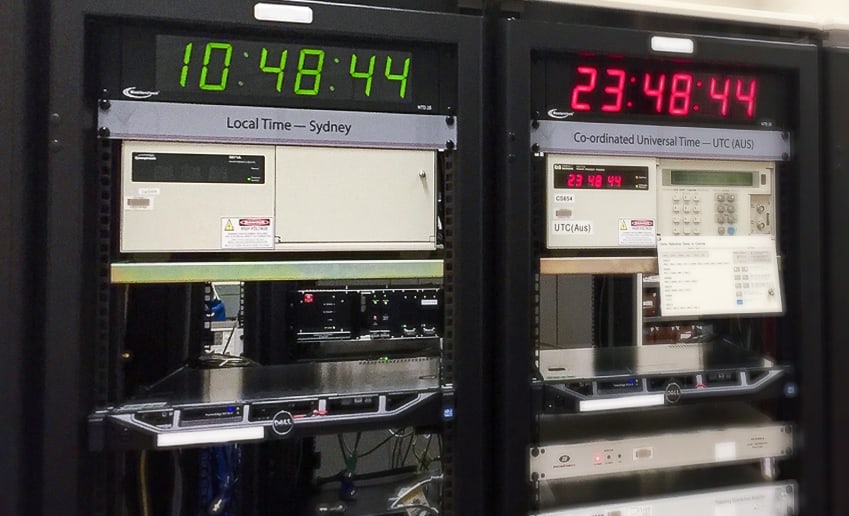
The NTC addresses this through a layered architecture. A small number of highly trusted reference nodes, connected to national reference time sources operated by the National Measurement Institute (NMI) and based on precise atomic clocks, provide a stable foundation. Surrounding them are lower-cost distribution nodes deployed across AARNet’s network.
A dedicated monitoring component continuously checks performance, effectively embedding an auditing function into the timing system itself. Rather than assuming everything is operating correctly, the architecture is designed to verify it.

The project also includes a calibration method that measures one-way delays during controlled intervals, allowing the system to identify and track asymmetry over time. Instead of ignoring distortions caused by routing changes and congestion, the NTC is built to detect, understand, and compensate for them.
These capabilities have the potential to establish a sovereign timing infrastructure that is largely independent of space-based timing systems such as GPS, and to improve the accuracy of Internet-based timing for applications previously requiring expensive hardware.
Backed by Australian Research Council (ARC) Discovery Project funding, the project reflects growing recognition that trusted time is critical to Australia’s digital infrastructure.
Feature photo: Ankit Goyal from AARNet, Dr Michael Wouter from NMI, and Professor Darryl Veitch from UTS with an atomic clock.
GPS is now integrated into all aspects of society, and if it is in trouble, much of our economy and many critical services are too."
Faculty of Engineering and IT at the University of Technology Sydney (UTS)